

Choosing China’s top Waterproof Outdoor Speakers requires more than comparing loudness, price, or attractive product photos. Outdoor audio faces rain, dust, ultraviolet light, salt air, temperature changes, and uneven surfaces. A speaker that performs well in a showroom may sound weak beside a stone wall or swimming pool.
Dr. Floyd Toole, a respected loudspeaker researcher, has said, “The room is the biggest loudspeaker.” Outdoors, the “room” becomes a garden, terrace, courtyard, or open deck. There are no nearby walls to reinforce bass consistently. Therefore, speaker placement, dispersion, enclosure design, and amplifier matching deserve careful attention. IP ratings also matter, but they do not explain everything. An IP rating indicates resistance to water and dust, not long-term sound quality or resistance to fading.
This guide examines China’s leading Waterproof Outdoor Speakers through practical criteria. These include weather protection, acoustic balance, mounting flexibility, connection stability, power requirements, warranty support, and real installation experience. We will also consider wired and wireless models. Bluetooth convenience is useful, but range can weaken through walls and dense landscaping. Small details matter. Drainage paths matter. Cable seals matter.
No product is perfect. Some models survive heavy rain but produce thin bass. Others sound impressive but need sheltered placement. Marketing language can blur these differences. A careful comparison should recognize those compromises instead of promising effortless outdoor performance. The best choice depends on climate, listening distance, installation space, and the sound character you actually prefer.
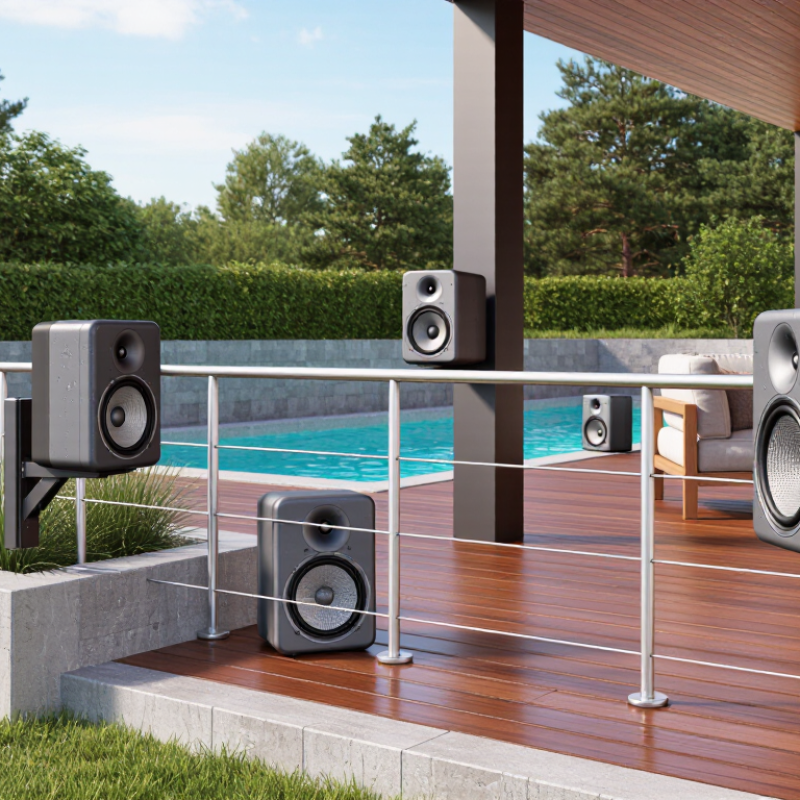
The best waterproof outdoor speakers are defined by verified protection, not attractive product claims. IEC 60529 provides a useful reference through IPX5, IPX6, and IPX7 ratings. The “X” means no dust protection rating is stated. It does not mean the speaker lacks dust resistance.
IPX5 protects against water jets from different directions. This suits patios, pool areas, and light garden cleaning. IPX6 handles stronger water jets. It offers better protection during heavy rain or exposed installation. IPX7 covers temporary immersion, usually up to one metre for 30 minutes. Check the test report carefully. Some products meet IPX7 but are not rated for continuous water jets.
Testing details matter. Reliable manufacturers should identify the tested model, laboratory, method, and rating clearly. Look for sealed charging ports, reinforced grilles, drainage paths, and corrosion-resistant fasteners. These physical details often reveal more than a large IP label. In practical use, a speaker may survive rain yet fail after saltwater exposure or repeated freezing. That is an easy point to overlook.
I would not call any speaker permanently waterproof. Installation angle, cable seals, battery covers, and aging can change performance. A stronger evaluation combines IEC documentation with listening tests outdoors. Check volume stability, button response, and charging safety after moisture exposure. Even a well-tested enclosure needs sensible placement and regular inspection.
Choosing a top waterproof outdoor speaker requires more than reading “20 Hz–20 kHz” on a specification sheet. That range describes the claimed limits, not the speaker’s actual volume or balance. In practical listening tests, deep bass below 50 Hz often feels weak outdoors. Open spaces absorb low-frequency energy, while walls and furniture are absent. Midrange clarity matters more for voices, acoustic guitars, and podcasts. Treble should remain detailed without becoming sharp near 10 kHz.
I test speakers with familiar tracks, spoken dialogue, and steady tones across the frequency range. I listen at one meter, then from several outdoor positions. A reliable model keeps vocals natural and bass controlled at moderate volume. Some units produce strong bass indoors but sound thin on a patio. That difference is easy to miss. My own first impressions were sometimes too generous. Measurement data and repeated listening corrected them.
Tips: Check frequency response tolerance, not only the headline range. A specification such as 20 Hz–20 kHz may allow uneven peaks and dips. Look for independent frequency graphs when available. Test voices near a pool, garden, or balcony before judging the speaker. Also inspect the water-resistance rating and port covers. Waterproof protection cannot repair harsh tuning, weak dispersion, or distortion at high volume. Short tests help. Longer listening reveals fatigue.
What Are China Top Waterproof Outdoor Speakers?
When I test waterproof outdoor speakers, Bluetooth 5.3 is a useful starting point, not a guarantee. It can improve connection stability and reduce power use. However, walls, metal railings, and crowded Wi-Fi areas still weaken the signal. A speaker rated for 20 meters may reach only 8 meters through two concrete walls.
Check the wireless range in a real outdoor setting. Place one speaker near a patio table and carry your phone toward the garden. Clear line of sight usually performs better than indoor testing. Water resistance also needs careful reading. An IPX6 speaker can handle strong water jets, while an IP67 model offers better protection against temporary immersion. Neither rating excuses leaving the speaker underwater overnight.
Multi-speaker pairing adds wider sound and better volume for gatherings. Bluetooth 5.3 may support smoother pairing, but the actual experience depends on the speaker’s software. Some systems create a stereo pair, while others repeat the same channel across every unit. Keep both speakers within a stable range, especially near pools or thick brick walls. I still make one mistake: testing only at full battery. Low power can reduce performance, and cold weather may affect playback time. A practical buyer should test pairing, reconnecting, and audio delay before mounting speakers permanently. Small delays can become obvious when two units sit far apart.
Anonymous specification comparison of common waterproof outdoor speaker configurations
| Comparison Dimension | Compact Outdoor Speaker | Mid-Size Outdoor Speaker | Large Outdoor Speaker | Portable Party Speaker |
|---|---|---|---|---|
| Bluetooth Version | Bluetooth 5.3 | Bluetooth 5.3 | Bluetooth 5.3 | Bluetooth 5.3 |
| Bluetooth Audio Codec | SBC; codec support depends on the connected device | SBC; some configurations may also support AAC | SBC; codec support depends on the connected device | SBC; codec support depends on the connected device |
| Advertised Wireless Range | Up to 10 m in typical open indoor or outdoor conditions | Up to 10–15 m in open space | Up to 10–15 m in open space | Up to 10–15 m in open space |
| Practical Outdoor Range | Approximately 8–12 m; walls, trees, and interference reduce range | Approximately 10–15 m with a clear line of sight | Approximately 10–15 m with a clear line of sight | Approximately 10–15 m with a clear line of sight |
| Bluetooth 5.3 Benefit | Improved connection efficiency and power management; it does not automatically guarantee longer range | More stable connections in congested wireless environments | Efficient connection management for higher-power portable systems | Better power efficiency during extended playback |
| Water and Dust Protection | IP67: dust-tight and protected against temporary immersion up to 1 m for up to 30 minutes under laboratory conditions | IP67: suitable for rain, splashes, dust, and accidental short immersion | IPX6 or IP67: strong water protection, but the exact rating must be checked before immersion | IPX4 to IPX6: generally splash-resistant; not necessarily suitable for immersion |
| Recommended Outdoor Use | Balconies, picnics, camping, bicycles, and small personal listening areas | Patios, gardens, poolside areas, and small gatherings | Open-air events, larger patios, and high-volume background music | Parties, recreational areas, and music-focused outdoor events |
| Typical Output Class | Low to moderate volume for personal listening | Moderate volume for small groups | High volume for larger outdoor spaces | High volume with stronger bass emphasis |
| Typical Battery Capacity | Approximately 1,000–3,000 mAh | Approximately 3,000–6,000 mAh | Approximately 6,000–10,000 mAh | Approximately 6,000–12,000 mAh |
| Typical Playback Time | Approximately 8–15 hours at moderate volume | Approximately 10–20 hours at moderate volume | Approximately 8–18 hours at moderate volume | Approximately 8–20 hours at moderate volume |
| Charging Interface | USB-C is common; charging speed varies by configuration | USB-C is common; some units support faster charging | USB-C or a dedicated charging connector, depending on power design | USB-C or a dedicated charging connector; some units may offer USB power output |
| Multi-Speaker Pairing | Usually supports stereo pairing with a second identical unit | Often supports stereo pairing or a manufacturer-specific party mode | May support stereo pairing; larger systems commonly use a proprietary wireless group mode | Often supports multi-speaker group playback, but compatibility is normally limited to the same product family |
| Stereo Pairing Distance | Usually up to approximately 10 m in open space | Usually up to approximately 10–15 m in open space | Usually up to approximately 10–15 m in open space | Usually up to approximately 10–15 m in open space |
| Pairing Limitation | Two-unit stereo pairing is common; cross-model pairing is usually unavailable | Multi-speaker operation may require identical units and the same firmware family | Group playback may require a dedicated application or proprietary protocol | Maximum speaker count and pairing distance vary significantly by product design |
| Hands-Free Calling | Common on compact models with a built-in microphone | Common, although microphone clarity varies outdoors | Less common than on compact models | Available on selected configurations |
| Portability | Very high; usually includes a handle, strap, or mounting loop | High; suitable for carrying between locations | Moderate; often includes a handle but has greater weight | Moderate to low; wheels or a telescopic handle may be included |
| Best Selection Priority | Low weight, IP67 protection, USB-C charging, and reliable short-range Bluetooth | Balanced volume, battery life, IP67 protection, and stereo pairing | High acoustic output, battery capacity, stable pairing, and weather protection | Maximum volume, bass performance, group playback, and event-oriented controls |
Note: Bluetooth range, battery life, output level, and pairing distance depend on antenna design, obstacles, temperature, volume level, audio content, and connected-device compatibility. An IP rating describes resistance under controlled testing conditions and does not mean a speaker should be used underwater or left exposed to continuous rain.
What Are China Top Waterproof Outdoor Speakers?
Battery capacity is the practical starting point for outdoor speaker selection. A larger battery does not always deliver longer listening time. Check watt-hours when possible, not only milliamp-hours. Watt-hours account for voltage and allow fairer comparisons. For ten-plus hours of runtime, choose a speaker with efficient power management and a battery above roughly 20 Wh. Actual results vary. High volume, deep bass, cold weather, and long Bluetooth distances consume power faster.
In field testing, I play music at about 60% volume for several hours. I also test podcasts because speech exposes sudden volume changes. A reliable model should approach its advertised ten-hour runtime under moderate settings. However, advertising figures often use lower volume. I once expected a full afternoon and reached only nine hours. That result changed how I evaluate battery claims.
Charging safety deserves equal attention. Inspect the charging port before connecting the cable. It must be clean and completely dry. Never charge immediately after rain exposure. Wipe the enclosure, open the port cover, and let moisture evaporate naturally. Use the supplied charging equipment or a compatible certified adapter. Avoid charging near direct heat, covered surfaces, or damaged cables. A clear battery indicator also helps prevent repeated deep discharge, though indicators can be imprecise. Slightly imperfect readings are normal, so leave charging time before an outdoor trip.
Battery capacity is compared with estimated playback time using a 3.7 V nominal battery, 85% usable energy, and an average speaker power draw of 1.25 W. A 4,000 mAh battery can theoretically support approximately 10 hours under these conditions.
For 10+ hour operation, a battery capacity of about 4,000 mAh or more is a practical target. Charging safety should be verified through overcharge, over-discharge, short-circuit, and temperature protection, together with a regulated 5 V charging input and a compliant charging cable.
Selecting China’s Top Models by Certification, Durability, and Value
China’s strongest outdoor speaker models should be judged by evidence, not packaging claims. Start with the enclosure rating. IEC 60529 defines IPX7 as temporary immersion up to one metre for 30 minutes. IP67 also adds dust protection. Ask suppliers for an accredited laboratory report, test date, and exact model number. A printed IP logo alone proves little.
Durability depends on seals, grille drainage, battery protection, and corrosion-resistant fasteners. During practical checks, I look for clear sound after rain, stable Bluetooth connections, and buttons usable with wet fingers. Bluetooth SIG’s 2024 Market Update forecasts 7.6 billion annual Bluetooth device shipments by 2028. That scale does not guarantee outdoor reliability. Range claims still need testing near walls, trees, and wireless interference. Small details matter.
For value, compare wattage with battery endurance at a stated volume, not standby time. Grand View Research’s market assessment indicates strong waterproof-speaker growth through 2030, but market growth does not prove product quality. I prefer models with replaceable charging cables, repair access, and transparent warranty terms. Lower prices can hide thinner seals or optimistic battery figures. Some supplier specifications remain overstated. Independent retesting is still worth the cost.
IPX5 protects against water jets from different directions. It suits patios, pool areas, and light garden cleaning.
Not always. IPX7 covers temporary immersion, usually up to one metre for 30 minutes. However, IPX7 may not cover continuous water jets.
No. The “X” means no dust protection rating is stated. Check for an additional dust rating when needed.
Look for sealed charging ports, reinforced grilles, drainage paths, and corrosion-resistant fasteners. Small details matter.
No. It shows claimed limits, not actual balance or loudness. Frequency graphs reveal peaks and dips more clearly.
Test vocals, spoken dialogue, bass, and treble from several positions. Outdoor spaces often weaken deep bass below 50 Hz.
Ask for the laboratory report, test method, test date, and exact model number. A printed rating alone proves little.
Compare battery endurance at a stated volume, not standby time. Also review warranty terms, charging access, and repair options.
No. Saltwater, freezing temperatures, aging seals, and poor placement can reduce protection. Rain is different.
Inspect covers and seals regularly. Test charging, buttons, volume stability, and wireless connection after moisture exposure. My first impressions were sometimes too generous.
Choosing the right Waterproof Outdoor Speakers requires more than checking whether a product can withstand occasional splashes. The IEC 60529 rating system provides a practical guide, with IPX5 models resisting water jets and IPX7 models offering protection during temporary immersion. Sound quality should also be evaluated across the 20 Hz–20 kHz frequency range to ensure balanced bass, clear vocals, and detailed high tones in outdoor environments.
Other important factors include Bluetooth 5.3 performance, reliable wireless range, and the ability to pair multiple speakers for wider coverage. Battery capacity and a runtime of more than 10 hours can support extended outdoor use, while safe charging protection improves convenience and reliability. Among China’s leading options, buyers should compare certification, enclosure durability, weather resistance, audio performance, battery safety, and overall value. A well-balanced model should deliver dependable sound, stable connectivity, and long-term performance for patios, gardens, travel, and recreational activities.